
Planning a house rewire can feel daunting if you are not sure what is involved. Understanding the stages, the disruption, and how electricians work will help you make informed decisions and prepare your home properly.
Signs your home may need a rewire
Not every older property needs a full rewire, but there are warning signs that your wiring may be outdated or unsafe. Age is often the first clue. If your property has not been rewired in 25 to 30 years, it is worth having it checked, especially if no paperwork exists.
Visible signs can include old style fuse boxes with rewireable fuses, fabric or rubber insulated cables, or a lack of RCD protection. You might also notice repeated tripping, lights that flicker, or sockets that feel warm to the touch, which can indicate underlying faults.
Regularly tripping circuits or blown fuses
No earthing on metal light fittings or pipes
Very few sockets in each room, with heavy reliance on extension leads
Results from an Electrical Installation Condition Report (EICR) showing C1 or C2 codes
A modern EICR is one of the clearest indicators. If your report recommends a rewire, or highlights serious issues such as no earth on lighting circuits, damaged insulation, or overheating at terminations, it is sensible to take that advice seriously from a safety perspective.
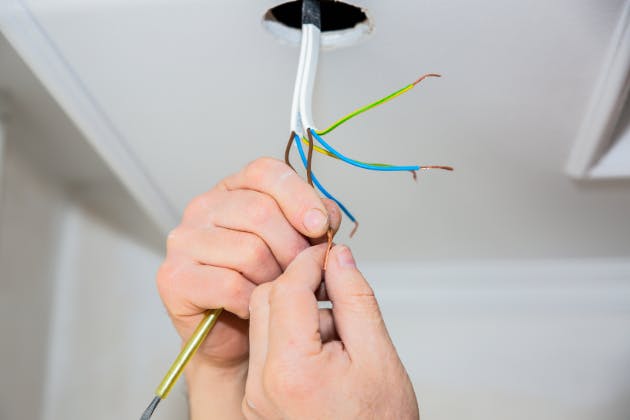
How electricians survey and plan your rewire
Before any cables are chased into walls, a qualified electrician will survey your home to understand the current installation and discuss how you actually use each room. This survey forms the basis of the scope of works and the circuit layout.
They will typically count existing sockets and lights, check your consumer unit, assess earthing and bonding, and note access points such as lofts, cellars and outbuildings. At this stage, you can talk about future needs like EV charging, garden lighting, or extra data points for home working.
Socket and lighting plans are then sketched room by room. Modern rewires usually include more sockets to reduce extension leads, separate circuits for high demand appliances, and suitable lighting circuits so that not everything goes off if one breaker trips.
Special attention for kitchens, bathrooms and outdoors
Kitchens and bathrooms are treated as special locations because of higher risks from water and heavy loads. Your electrician will plan dedicated circuits for cookers and hobs, extraction fans, and often for key appliances. Bathrooms will be designed around safe zones with appropriate IP rated fittings.
Outdoor circuits, such as garden sockets, sheds and external lighting, need particular care with protective devices and burial depths for cables. All of this should be discussed at the planning stage so there are no surprises once work begins.
First fix and second fix explained
A rewire is usually split into two main phases: first fix and second fix. Understanding the difference helps you see what will be happening in your home on each visit and how disruptive it may feel.
What happens during first fix
First fix is the messy, structural stage. This is when old cables are removed where practicable, new routes are cut or chased into walls, and cables are run through floors, ceilings and walls to each point that will need power or lighting.
Back boxes for sockets and switches are fitted, and cables are clearly labelled and prepared at the consumer unit. At this point you will see lots of bare boxes, exposed chases and loose cable ends. It can look worse before it looks better, but this is where the core of the new installation is put in place.
What happens during second fix
Second fix is cleaner and more focused on finishing. Once the chases have been filled and any plastering has been completed, your electrician returns to fit the visible accessories such as sockets, switches, light fittings and the new consumer unit if it is being upgraded.
They will connect each cable to the correct device, label circuits properly, and start preliminary testing. By the end of second fix your system will look complete and most power and lighting will be operational, ready for full testing and certification.
Partial rewire versus full rewire
Not every property needs every cable replaced. In some cases a partial rewire is appropriate, for example if only an extension, kitchen or upstairs circuit is outdated or damaged while the rest of the wiring is modern and tested as safe.
The decision usually rests on the condition and age of the existing cables, the findings of an EICR, and how practical it is to separate new and old wiring. If too much of the system is compromised, a full rewire is often safer and more cost effective in the long term.
A consumer unit upgrade can sit alongside either option. Sometimes the wiring is sound but the fuse board is obsolete, with no RCD protection. In that case, upgrading to a modern consumer unit with RCDs and, where appropriate, RCBOs can significantly improve safety and bring the installation in line with current standards.
How long a house rewire can take
The duration of a rewire depends on the size and layout of your property, the accessibility of existing wiring routes, and whether the house is occupied during the work. As a rough guide, a typical occupied two to three bedroom house might take around 5 to 10 working days across the two fixes.
Larger properties, homes with complicated layouts, or projects that include outbuildings, garden circuits or extensive smart controls can take longer. If the property is empty, work can often progress more quickly because rooms can be cleared once and left that way until completion.
Your electrician should give you a realistic schedule as part of the quotation, including any gaps between first and second fix to allow for plastering or other trades.
Preparing your home for a rewire
A little preparation goes a long way in reducing stress during a rewire. Electricians need clear access to walls, sockets, switches, the consumer unit, and any voids where cables run such as lofts and underfloor spaces.
Before work starts, move furniture away from walls as much as you reasonably can and take pictures and mirrors down. Pack away ornaments and valuables to protect them from dust and vibration, and discuss with your electrician what coverings they will provide and what you may want to add.
Clear access to loft hatches, meter cupboards and consumer units
Agree which rooms will be tackled first and where you can “camp out”
Plan for limited power or lighting in some areas during the work
Keep pets and children away from work areas for safety
If you have outbuildings, garages or garden lighting to be included in the rewire, make sure gates and sheds are unlocked and any storage blocking cable routes is moved in advance. Good communication with your electrician about your daily routine will help them sequence the work to minimise disruption.
Testing, certification and Part P notification
Once second fix is complete, thorough testing is carried out. This includes continuity checks, insulation resistance tests, verification of earthing and bonding, and tests of RCD performance to confirm that protective devices trip within the required times.
Your electrician will then issue an Electrical Installation Certificate for the work. For notifiable work in dwellings in England, such as a rewire, they must also notify Building Control under Part P, usually through their registration body. You should receive confirmation of this notification along with your certificate.
It is sensible to keep this documentation safely with any EICR reports. It will be useful for insurance purposes and when you come to sell the property, as it proves that the electrical work has been carried out and tested by a competent person.
Next steps for homeowners in Knebworth
If you are in Knebworth and thinking about a full or partial rewire, the best starting point is a proper survey and, where appropriate, an up to date EICR. This will show whether you truly need a rewire or if a consumer unit upgrade or targeted work would be sufficient.
D C Electrix Ltd can assess your existing installation, talk through circuit layouts and socket positions, and give you a clear plan for your house rewire, including how to phase the work to suit your home life. To arrange a survey and discuss your options, contact D C Electrix Ltd on 07415049613.